مفهومُ الخَضرمةِ وانعكاساتُها على اللغةِ في عصرِ صدرِ الإسلام
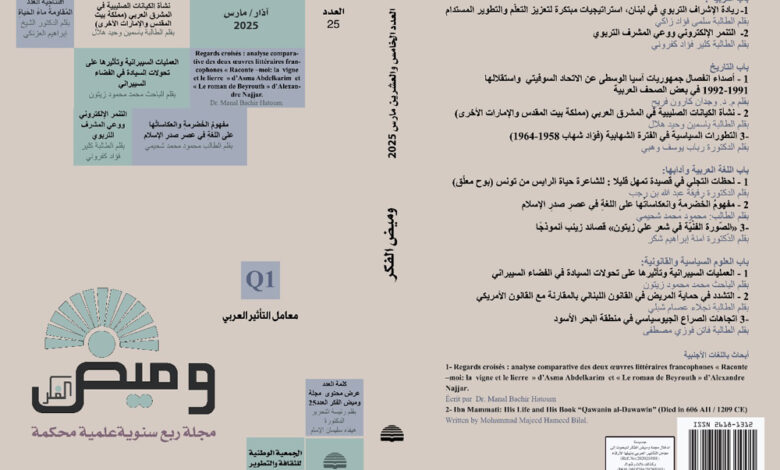
عنوان البحث: مفهومُ الخَضرمةِ وانعكاساتُها على اللغةِ في عصرِ صدرِ الإسلام
اسم الكاتب: محمود محمد شحيمي
تاريخ النشر: 25/03/2025
اسم المجلة: مجلة وميض الفكر
عدد المجلة: 25
تحميل البحث بصيغة PDFhttps://doi.org/10.71438/2517
مفهومُ الخَضرمةِ وانعكاساتُها على اللغةِ في عصرِ صدرِ الإسلام
The Concept of “Khudrama” and Its Reflections on Language in the Early Islamic Literary Period
بقلم الطالب: محمود محمد شحيمي
طالب دكتوراه في جامعة بيروت العربية- قسم اللغة العربية وآدابها
إشراف الدكتور بشير فرج
Researcher: Mahmoud Mohamed CHEHIMI
Beirut Arab University- Department of Arabic Language
Mah.chehimi@gmail.com
تاريخ الاستلام: 25/1 /2025 تاريخ القبول: 4/ 2/ 2025 تاريخ النشر:25/3/ 2025
مستخلص البحث
تتناولُ هذه الدراسةُ بالبحثِ مفهومَ الخضرمة، وتحدِّد معناه اللغويّ وكذلك الاصطلاحيّ، ثمّ ترصد تطوّر هذا المفهوم وتعدّدَ دلالاته عبر التاريخ مع لحظِ أسبابِ هذا التطوّر. وتعالجُ إشكالية تجلّي خضرمةِ الشعراء على اللغة في عصر صدر الإسلام من خلال انعكاسها على شعرهم على مستوى الكلمة والجملة والنصّ.
توصّلت الدراسة إلى تعدّد الدلالات اللغويّة للخضرمة بين معانٍ كثيرة كالقطعِ والسعة، والهُجنة، والاختلاط، والجود وغيرها، وتوزّع المفهوم القديم لها بين ثلاثةِ معانٍ، ثم توسَّع هذا المفهوم لاحقًا في الاستعمال اللغويّ المعاصر استنادًا إلى مبدأ التطور الدلالي، ليشملَ معاني سعةِ الخبرةِ والثقافة، أو قِدَمِ العهد بالسياسة ومعايشةِ أجيالٍ وعهودٍ تاريخيّة. وكانت أبرز انعكاسات الخضرمة على الكلمة من خلال دخول مفرداتٍ جديدةٍ تنتمي إلى الحقل المعجميِّ الإسلامي، وعلى الجملة من خلال الاقتباس الكليّ أو الجزئيّ من القرآن الكريم، وعلى النصّ من خلال ظهور أغراضٍ شعريةٍ جديدة أو تأثُّرِ أغراضٍ قديمةٍ كانت موجودةً في الجاهلية واكتسبت نفَسًا إسلاميًّا جديدًا.
كلمات مفتاحية: الخضرمة- الشعراء المخضرمون- العصر الجاهليّ- عصر صدر الإسلام- الكلمة- الجملة- النص.
Abstract:
This study examines the concept of “Khudrama,” defining its linguistic and technical meanings, and traces the evolution of this concept and the multiplicity of its connotations throughout history, identifying the reasons for its development. The study addresses the issue of the manifestation of the poets’ influence on the language during the early Islamic era, through its reflection in the poetry of the veterans at the levels of the word, the sentence, and the text.
The study concludes that the linguistic connotations of Khudrama are diverse, encompassing meanings such as cutting, breadth, hybridity, mixture, generosity, and others. The original concept was divided into three main meanings, which later expanded to include meanings related to broad experience and culture, or to long exposure to politics and interaction with different generations and historical periods, based on the principle of semantic development. The most notable reflections of Khudrama on words are through the introduction of new terms belonging to the Islamic lexical field. As for sentences, it is evident in the total or partial quotations from the Qur’an. At the level of the text, the influence is seen in the emergence of new poetic themes or the transformation of old themes from the pre-Islamic era, which acquired a new Islamic dimension.
Keywords: Khudrama, Contemporaneous of Two Epochs, Pre-Islamic Era, Early Islamic Era, Word, Sentence, Text.